

How to outgrow transactional relationships
Why they're on the rise, and how to escape the need for control

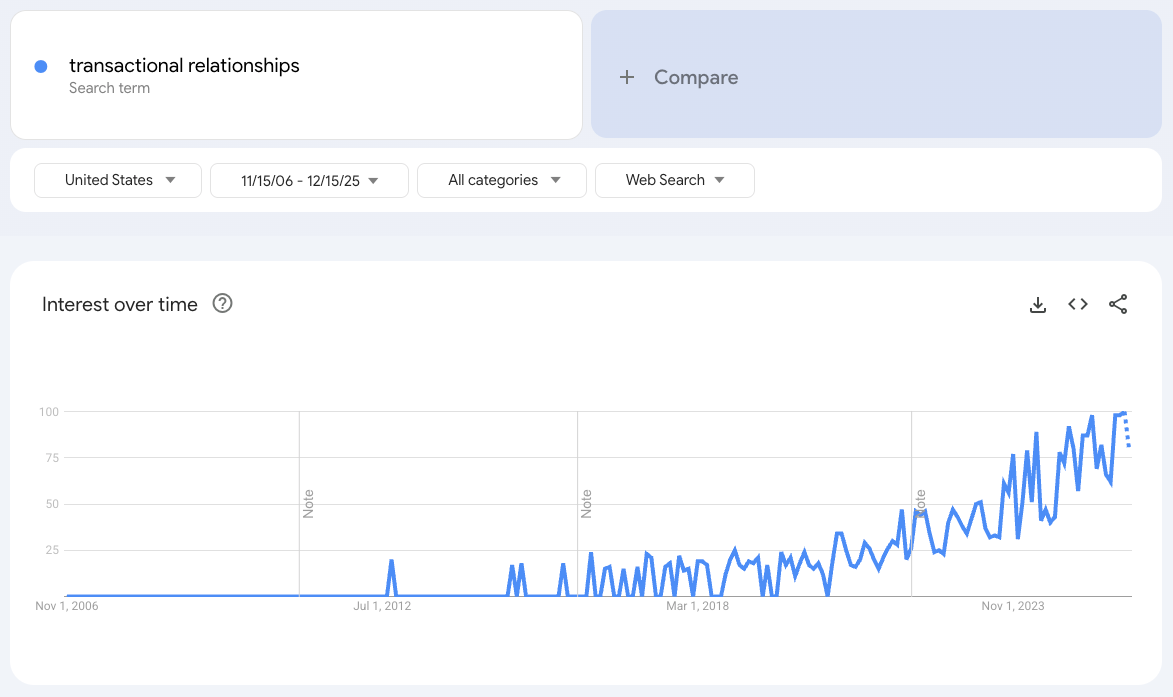
‘Transactional relationships’ are a hot-button topic these days, and for good reason.
A transactional relationship is one in which you evaluate the other based on what they can do for you, there’s some kind of explicit or implicit negotiation, and you treat that relationship as an ongoing transaction.
They’re on the rise, and that’s because our broader culture itself is increasingly transactional.
Why? It’s profitable to facilitate financial exchanges. Making it easy for someone to find and pay for a dog-walking service is way more profitable than a service where you can find and ask a friend to do it for free. The easier you make transactions, the less you rely on real relationships.
The most famous study around transactional relationships is about a daycare in Israel; parents showed up late to pick up their kids, so the center instituted a late pickup fee to discourage it. The result? Even more parents picked up their kids late.
Why? Instituting a late fee turned the relationship between daycare workers and parents into a transaction. Money created distance. But it also created the perception of comparative value.
Before, when daycare ended, parents had a moral imperative to pick up their kids on time. But with the late pickup fee, parents were freed from moral considerations. They were no longer ‘part of the same group’ as the daycare workers. Instead, they became ‘at a distance.’
Unpacking transactional relationships: They’re about distance and control.
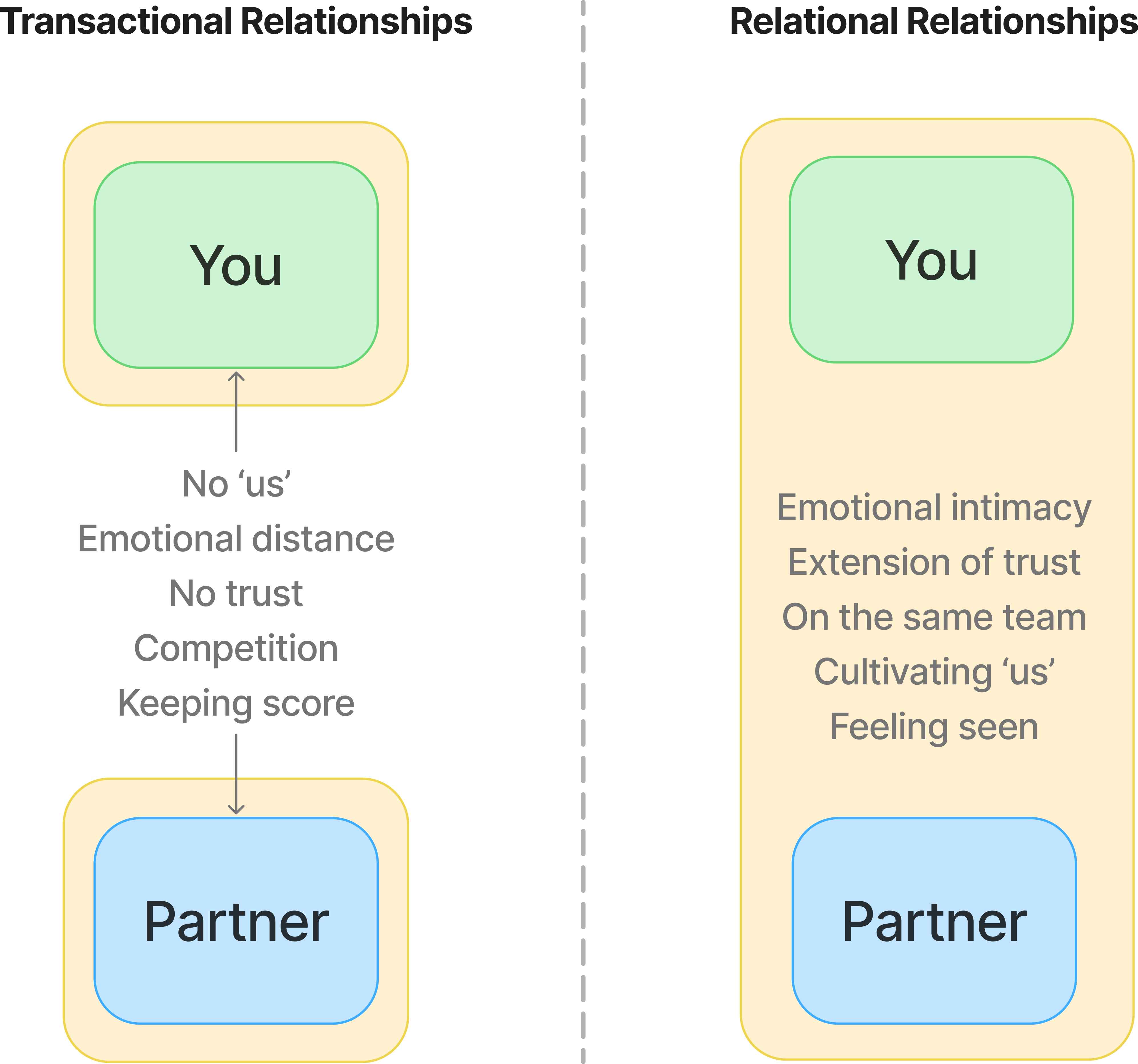
Transactional romantic relationships are unsatisfying and lack the emotional intimacy humans need. This is true. But it’s not the real story.
The deeper story is that transactional relationships enable people to maintain perceived control of their own life, whereas real relationships require you to let go, in a sense, of control. In a real relationship, there’s compromise, growth, change, and a prioritization of ‘us’ over ‘me’.
Our cultural shift towards transactional relationships is about the growing perception that control over your own life is more important than connection.
That prioritization of maintaining control stems from our culture of convenience, where the world is expected to bends to individuals’ needs and desires, rather than asking people to change. A microcosm of this dynamic can be seen in the debate of whether you should pick up friends and family from the airport.
People don’t want to think of themselves as someone who cleans. So they hire a cleaner on Tidy.com. People don’t want to go out of their way for others.
And over time, the less experience people have with relinquishing control to be a part of something larger, the scarier it becomes.
So transactional relationships are becoming more widespread because people feel an increased compulsion to control their own lives, which requires living at a distance from others.
In the wake of growing convenience culture, fewer and fewer people are accustomed to the idea of letting themselves be changed to get what they want.
Freeing yourself from the need for control
The compulsion to control one’s life stems from the idea that we are our decisions, and that being a part of something represents an existential threat to our individualism. Realizing that hyper-individualism is the problem, and learning to focus less on yourself will help.
Here’s what to focus on instead:
Your life goals. If you want to get married, you’ll need to shift your priorities away from being an individual and learn to compromise.
Your values. Think about hyper-individualism as a value set you’ve unintentionally inherited, one that hasn’t served you well. Identify new values and then figure out what it means to live in obedience to them.
Your relationships. Focusing on the people who matter most to you, whether friends, family, (and eventually) significant other, will help you shift away from worrying about yourself and your own control.
Your journey & destination. Think about the way you’ve been living your life as indulging in fear. That’s what hyper-individualism is, after all. Explore what your life journey might look like if you imagine a destination-future in which you’re more connected.
Your interactions. Experiment with giving more than you ask for, rather than needing to make your interactions about yourself. Try asking what you really want for and experiment with expressing your true feelings. How does it feel to take that risk?